

Blog
Dye Lot Matching in Natural Stone: What to Know Before You Specify

Dye Lot Matching in Natural Stone: What to Know Before You Specify
Every natural stone project carries a variable that doesn’t show up on a spec sheet: the lot. Two orders of the same product, placed weeks apart, can pull from different production runs, and those runs are rarely identical. Understanding how lots work, and how they’re tracked, is the difference between a project that reads as one continuous material and one that reveals its seams.
At The Mosaic Shop, dye lot management isn’t a customer service afterthought. It’s built into how we track and allocate inventory from the moment stone enters the warehouse.
What a Dye Lot Actually Is
A dye lot is a single production run of stone, quarried and processed together. Because natural stone forms geologically, not manufactured to a fixed standard, no two lots are identical. Veining density, background tone, and color saturation can all shift subtly from one lot to the next, even within the same named product.
This isn’t a flaw in the material. It’s the nature of it. A slab of Calacatta pulled from one lot and a slab from another will both be authentically Calacatta, but side by side, a trained eye, or a client standing in their finished kitchen, will notice the difference.
Two orders of the same product, placed weeks apart, can pull from different production runs, and those runs are rarely identical. Re-orders must always specify from the previous lot.
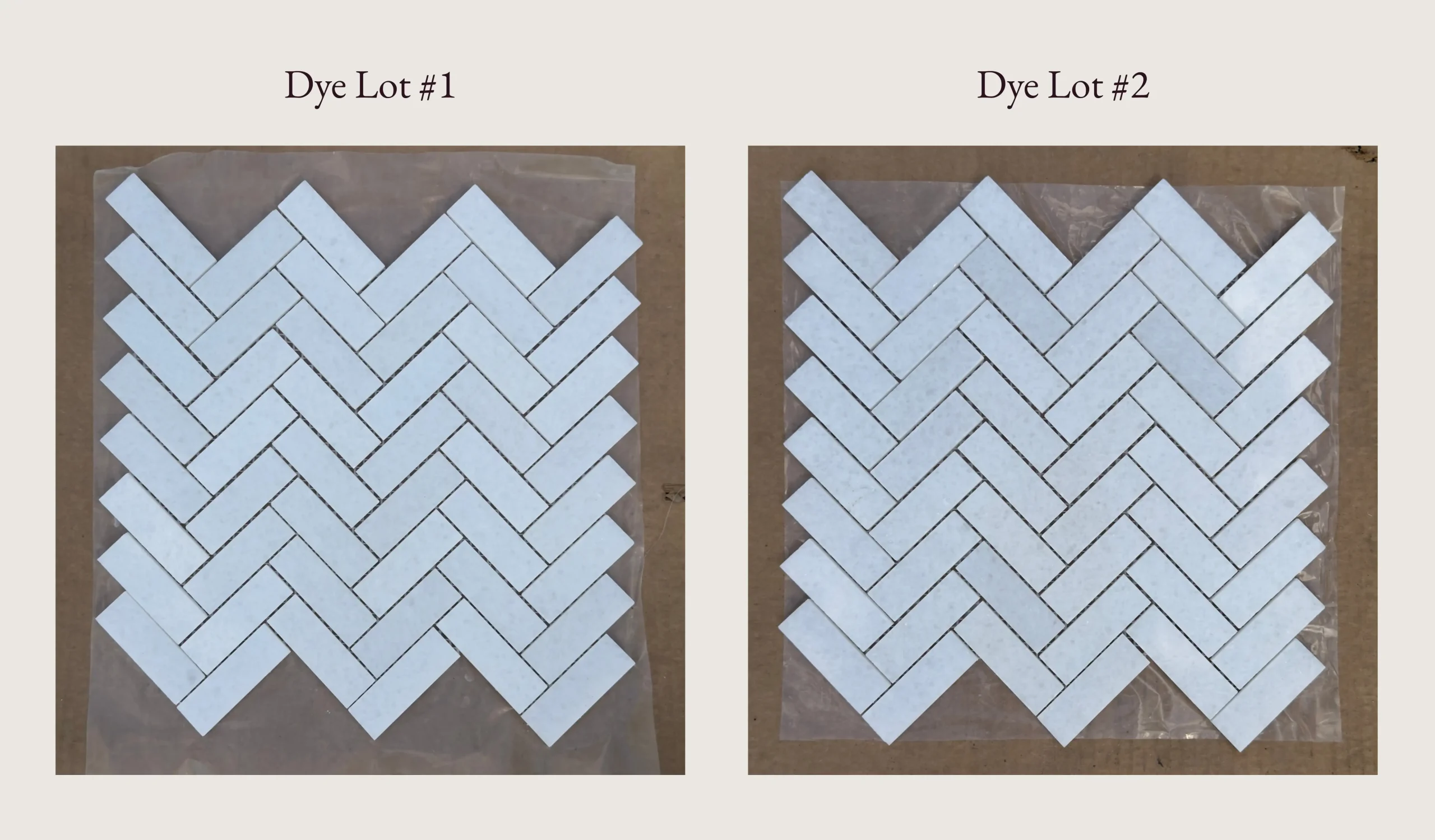
Two dye lots of the same herringbone mosaic, shown side by side. Subtle differences in tone and veining are natural to stone and are why lot consistency matters at the spec stage.
Why This Matters at the Spec Stage
The risk isn’t usually in a single room. It’s in projects that span multiple orders: a primary bath and a powder room specified months apart, a large kitchen requiring a reorder mid-installation, or a multi-unit project where consistency across units matters. If lot tracking isn’t built into how a supplier manages inventory, a reorder can arrive visibly different from the original, and that difference becomes the designer’s problem to explain, not the supplier’s.
This is why we track inventory at the dye lot level, not just the product level. When an order is placed, allocation pulls from the smallest available lot first, which keeps larger, more consistent lots in reserve for projects that need volume. Lots are never mixed within a single order. What ships together comes from the same run.
What to Ask Before You Specify
A few questions at the spec stage prevent problems at the install stage:
- Does the supplier track inventory by dye lot, or only by product?
- Can they confirm a large order will ship from single lot?
- If a reorder is likely, can they flag lot changes before the order ships, not after it arrives on site?
Suppliers who can answer these clearly are suppliers who understand that natural stone is being specified into real projects with real client expectations, not sold as a uniform project. This is the level of detail our trade program is built around.
Setting Expectations With Clients
Even with careful lot tracking, some variation is inherent to natural stone, and that’s worth communicating early. A sample shows the range a client should expect, not a guarantee of an exact match to a photograph. Framing that conversation before installation, rather than after, keeps variation from reading as a defect when it shows up as character.
We work from that same principle internally. Every order is fulfilled with lot consistency as the priority, but the material itself will always carry the natural range that makes it stone rather than a manufactured surface.
The Takeaway
Dye lot management is invisible when it’s done well and expensive when it isn’t. A project that reads as cohesive, even across multiple orders and installation phases, isn’t an accident. It’s the result of a supplier who tracks inventory with that outcome in mind from the start.
If you’re specifying natural stone regularly, apply for a trade account to get access to consistent lot allocation, trade pricing, and a dedicated sample process built for projects like yours.
More from The Mosaic Archive
Is Mother of Pearl Tile Durable? Care, Sealing, and What to Expect

Dye Lot Matching in Natural Stone: What to Know Before You Specify
THE COLLECTION
Find the right tile
for your space.
Natural stone mosaics for kitchens, bathrooms, and every space that deserves something permanent. Shop all products and order samples to see the magic in your space.